
Norway's Fjords: Chasing Waterfalls & Wonder
Updated: Sep 23
I’m not sure why my brain wasn’t quite grooving around this portion of the trip.
It wasn’t the five straight days of hiking - I'd done my daily hill climbs on the treadmill to prepare. But…
My knee has a history.
My backpack has limits.
And while I love beautiful scenery as much as the next traveler, I also appreciate a comfortable hotel, a great dinner, and the occasional glass of wine.
What I discovered was something completely different.
This wasn’t survival hiking.
It was luxury adventure - the kind that surprises you, stretches you, and still hands you a glass of wine at the end of the day.
Every morning, we laced up our boots and stepped into landscapes that looked borrowed from a fantasy novel. Misty valleys, glacier-fed rivers, waterfalls that sounded like applause - it was impossible not to feel small in the best possible way.
And every afternoon, we returned to historic hotels, incredible meals, and local hosts who somehow made Norway’s history feel as alive as its waterfalls. The contrast became its own kind of magic.
Somewhere between the glaciers and the fjords, I stopped clocking the miles and started paying attention to everything around me.
How could I not?
It’s hard to ignore that much beauty when it keeps unfolding in front of you, hour after hour, like the world is showing off.
The Guides Made the Trip
But what really makes these trips special is the people.
The guides love what they do. They know the region. They know the trails. They know when to explain, when to encourage, when to adjust, and when to quietly suggest eating your packed snack before your blood sugar turns you into a less charming version of yourself.
Got questions?
They have answers.
They’re prepared. They’re calm. And best of all, they take care of you.
The mastermind behind the people on this trip was Amy Quinn of Spirit Road Travel. She brought together this incredible group of women and made sure we'd be compatible spending five days on trails, ferries, buses, and hotel verandas together.
In other words, she was part travel designer, part camp director, and, on certain days, a professional herder of cats.
I cannot imagine navigating nineteen women.
Our local guides were friendly, knowledgeable, and deeply proud to be Norwegian. That pride came through every time they spoke about Norwegian history, folklore, farming life, glaciers, weather, or why we should absolutely not underestimate a stream crossing.
At Stalheim Hotel, our guide took us on a journey stretching back hundreds of years, from the Middle Ages to pre-World War II, explaining what life was like on a Norwegian farm, where entire families – grandparents, aunts, uncles, children – lived under one roof. They hunted together, ate together, slept together, and gathered in the one room that housed the fireplace.
Guided tour at Stalheim Hotel Mamma goat and babies grazing at the Stalheim Hotel
The tour made history come alive and left our group deeply grateful for central heating, indoor plumbing, and not having to sleep next to a goat.
Every guided experience had a similar purpose. It gave the scenery context. It added flavor. It told the stories you would never find by simply Googling pretty fjord near me.
Every Trail Felt Like Walking Through a Movie
“Look!”
“Not another waterfall”
“Or two.”
“Or five.”
This became our running joke while we hiked. They were everywhere - cascading down cliffs, threading through forests, appearing out of nowhere.
If you chase waterfalls, Norway is your place.
Village of Bakka Norway Tracey at the waterfall in Voss Norway View from train ride from Bergen to Voss
We were there at the perfect time of year. The glaciers were melting, the rivers were rushing, and the scenery looked like it had been arranged exclusively for us.
The sheep had also been busy having babies in multiples. Tiny twin lambs ran after their mothers, curious about the strangers walking through their impossibly green fields on our Royal Postal Road hike, which began in the small village of Bakka.
Twin sheep in Bakka Norway Hello! Why are you one my trail?
The melting ice created roaring streams that occasionally made you think twice before placing your boot. Our guide Brian had advised, “Before you lift your foot, have a plan.”
That became the voice playing on repeat in my mind.
The weather in Norway is wildly inconsistent. Some days, I felt like I burned more calories taking my rain gear on and off than I did actually hiking.
Dry. Warm.
Wet. Chilled.
Repeat.
At one point, it felt like an entire wardrobe change happening every twenty minutes.
Had I packed wrong?
No.
It’s just Norwegian weather.
Florida girl, live with it.
But that atmosphere is exactly what creates the glossy magazine pages: moss-covered forests, misty mountains, roaring streams, and those impossible green landscapes we experienced every single day.
On the day we were to hike the glacier, I suited up with crampons and a pickaxe and was just about to be tethered to the group when I thought, Wait a minute. I’ve already experienced a glacier in Iceland. Do I need to do this today?
A little voice said no.
So instead, I joined five other women on the alternative hike up the Bergset Valley, which took us to the glacier wall rather than onto the glacier itself.
It was glorious.
A bubbling stream ran beside us. The path was lined with stone walls. The glacier wall kept beckoning us forward like some icy, dramatic Norwegian diva.
Brian, our guide, recommended we taste the water from the stream. We filled our cups one after another.
It was crisp, cold, and delicious - the kind of water that makes you wonder why you ever settled for anything that comes out of a plastic bottle.
At the top of our five-mile trek, we stopped for snacks. Backroads has a nickname -Snackroads – and it is well earned. The treat for that day was cookies and hot instant coffee laced with a Nordic cream liqueur called Fjording.

Yes, that little voice had been correct.
This was exactly the day I needed.
The Hotels Were Destinations Themselves
The hotels on this trip weren’t just places to sleep. They were part of the story.
Our first night was at Stalheim Hotel, perched on a thousand-foot cliff with dramatic views of the Nærøyfjord Valley. The setting was pure Norwegian postcard: goats and babies frolicking in the fields, waterfalls in the distance, and enough mountain drama to make you forget you were wearing hiking pants.
That evening, after our folk museum tour, we had a private dinner in a restored barn, complete with faux reindeer hides draped over the benches.
Ironically, I ordered the goat for dinner - with a touch of guilt, given that I had been fawning over them in the fields earlier.
Regardless, the meal was delicious.
From there, a ferry ride through the dramatic Nærøyfjord – the world’s narrowest navigable fjord- and a short shuttle brought us to the charming village of Solvorn and the Walaker Hotel.
Surrounded by flower gardens and sitting directly on the Sognefjord, this family-built inn dates back more than 300 years and is still run by the ninth generation of the same family.
This hotel stole my heart.
Our final evening at Walaker was a beautifully prepared four-course dinner with wine pairings. I could spend a month here.
I was told that Queen Silvia of Sweden visits Walaker each year. After spending just two nights there, I completely understood why. The gardens, the quiet, the history, the impeccable service…it feels less like checking into a hotel and more like being welcomed into someone’s extraordinary family estate.
Naturally, my first question was:
“Excuse me…what month does the Queen usually come?”
Our final two nights were spent in Balestrand at the Kviknes Hotel. This Swiss-style inn, with its rambling verandas, offers panoramic views of Sognefjord, one of the longest fjords in the world.

Its history dates back to the 1700s, and it had one very notable summer visitor: Kaiser Wilhelm II, who arrived with his yacht and a flotilla of nine ships, complete with service officers.
Subtle.
The hotel also houses an expansive art collection, making it a perfect place to wander with an evening cocktail and pretend you are the kind of person who always knows what period a painting belongs to.
I may not always be that person.
But I do know a good veranda when I see one. And a good cocktail to accompany it.
Veranda at the Kviknes Hotel Parlor room view at the Kviknes Hotel
The Day That Stole the Show
Day four brought us to Fjaerland, a small dairy farming region at the foot of Jostedalsbreen, the largest glacier on the European mainland.
The morning began at the Glacier Museum – Norsk Bremuseum. The building itself is a work of art, designed by the same architectural firm that designed the 9/11 Memorial Pavilion in New York. It blends beautifully into the landscape, with sharp, glacier-like angles and towering hillsides as its backdrop.
Glacier Museum Norway Norsk Bremuseum
Inside, the museum keeps a block of ice from the Jostedalsbreen glacier on display.
You can touch it.
You’re literally placing your hand on something that formed during the last ice age.
Cool.
Or cold, I should say.
Wink wink.
Fjærland also has another claim to fame beyond its glaciers. It is the ancestral home of former U.S. Vice President Walter Mondale. His family name comes from Mundal, a tiny hamlet tucked into the valley. In 1986, Mondale helped open the Fjærland Tunnel, finally linking the village to the rest of Norway by road. Before this, the only way in or out was by way of the fjord.
The hike I chose that day was the Mundalsdalen Route, which took us through pastureland, across streams, and eventually through snow.
Thank goodness for hiking poles.
At the top, we ate our box lunches surrounded by yet another waterfall, another running stream, and a little bit of heaven.
Lunch at the top of Mundalsdalen Route Hiking the Mundalsdalen Route Norway
The trail led us back into the village, known as Norway’s Book Town, where outdoor bookshops and tiny book nooks are tucked into barns and boathouses, and unexpected corners throughout the village.
Glaciers, architecture, family history, waterfalls, snow, and books.
All in one tiny fjord village.
Norway's Book Town Floating Sauna Fjord Norway
As if that weren’t enough, our treat that day was the floating sauna.
Set right on the fjord and encased in glass, it gave us panoramic views while we warmed up inside.
This was the treat.
The challenge?
Jumping into the frigid fjord.
It was a heart-stopper. The minute your toe hits the water, your brain screams, “Absolutely not. Get out immediately.” (Cousin Deb literally screamed!)
Thankfully, the sauna was just across from the exit ladder, making it easy to climb out, hop back in, and pretend you had been brave the whole time.
I did it.
And yes, I was quite proud of myself.
Check, check on the bucket list.
My Favorite Unexpected Discovery
This trip was filled with unforgettable moments, but my favorite wasn’t a waterfall, a glacier, or even one of the spectacular hikes.
It was something nearly 900 years old.
After another short ferry ride across the Lustrafjord and a one-mile walk uphill through the tiny village of Ornes, we arrived at Urnes Stave Church.
Quietly overlooking the fjord since the 1130s, it is the oldest stave church in Norway and a UNESCO World Heritage Site.
Ornes cemetery Urnes Stave Church
One detail fascinated me.
Mounted on the exterior wall is a carved wooden panel from an even earlier church built on this site in the late 11th century. Rather than discard it during the rebuild, the craftsman preserved it because it represented an extraordinary piece of Viking art.
The carving depicts a stag being attacked by a serpent.
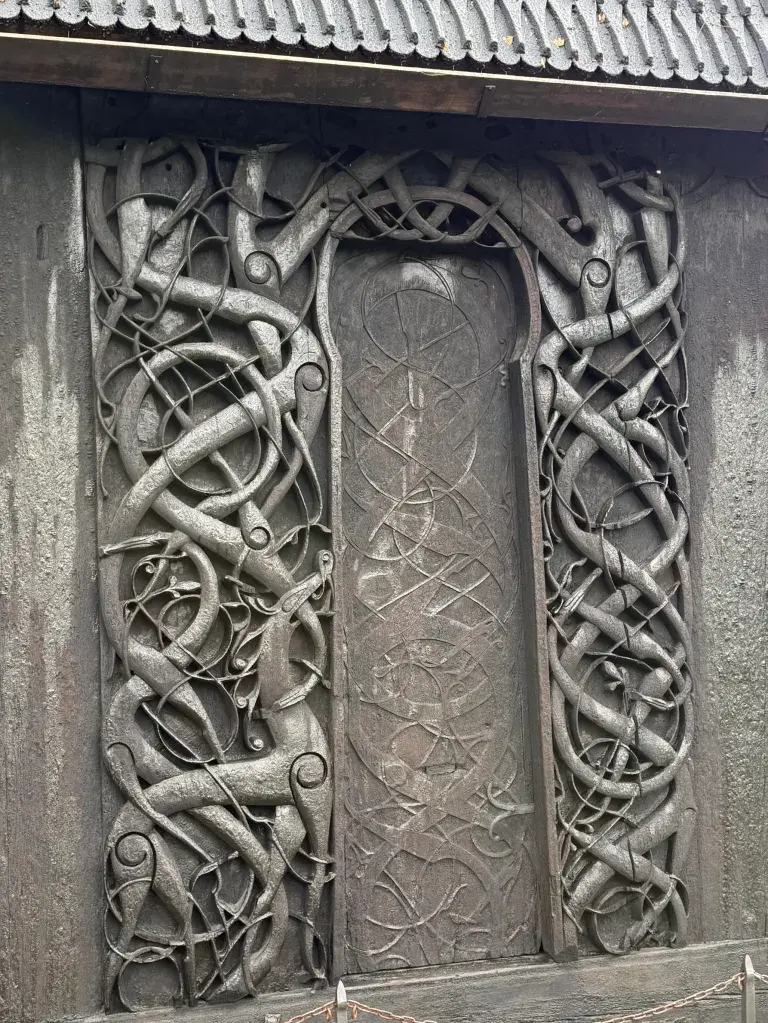
Norse mythology?
Perhaps.
Historians still debate its meaning today.
As captivating as the church itself was, our guide made it unforgettable.
She spoke with the kind of passion that can’t be memorized from a script. She explained how these remarkable churches were built over many years, with one group of craftsmen preparing the pine timbers before moving on to another project. The wood had to cure for years before the next artisans returned to continue construction.
I had never heard anything like it.
The church’s dramatic black exterior comes from centuries of pine tar treatments that protected it from Norway’s unforgiving coastal climate.
Stepping inside felt like walking backward through time.
The worn wooden floors creaked beneath our feet. Viking-inspired carvings intertwined with Christian symbols. Ancient artwork quietly told stories that have survived nearly a millennium.
Interior Urnes Stave Church Alter at the Urnes Stave Church Pew carving in Urnes Stave Church
It wasn’t the grandest church I’ve ever visited.
It wasn’t the most ornate.
But it may have been the one that made me stop, look around, and appreciate history the most.
Sometimes the places you never expected to visit become the ones you remember forever.
I came to Norway expecting to admire the fjords.
I left appreciating something much bigger.
The slower pace.
The tiny villages.
The family-owned hotels that have welcomed travelers for centuries.
The guides who knew every trail by heart.
The feeling that nature—not the itinerary—was setting the schedule.
Bergen introduced me to Norway.
These five days made me fall in love with it
I may or may not have checked Airbnb to see if I could extend my stay for the rest of the summer.
See you somewhere delicious.
STAMPED BY TRACEY